Schools play a vital role in shaping young minds, providing environments that need to be…
Could Your School Science Lab Be Holding Students Back?
Britain is crying out for more scientists, engineers and innovators, yet one of the biggest barriers to inspiring the next generation could be sitting in plain sight. Not the curriculum. Not the teachers. The laboratory itself, writes Katie Thompson, business development manager at David Bailey Furniture Systems.
A school science laboratory should be a place where curiosity is sparked, confidence grows and future careers begin. Instead, too many pupils are still being taught in ageing facilities that were designed for a different era. Poor layouts, worn workstations, inadequate storage and outdated fitted furniture can make practical science harder to teach, more difficult to supervise and less inspiring to experience.
That matters because practical science changes lives. It is often the first experiment, the first successful investigation or the first time a pupil looks down a microscope that turns an interest in science into a lifelong ambition. The Gatsby Foundation, whose work has helped shape practical science education across the UK, describes science as fundamentally a practical subject and argues that hands-on learning is essential if we are to develop the scientists, engineers and technicians of the future.
If we are serious about preparing young people for careers in science, technology, engineering and medicine, we should therefore start by asking a simple question. Are today’s school laboratories helping students realise their potential, or quietly holding them back?
Delivering outstanding practical science depends on far more than talented teachers. It requires laboratories that are safe, durable, flexible and designed specifically for the demands of modern education.
All this means that for schools investing in new laboratories or refurbishing existing science facilities, fitted furniture has become one of the most important decisions they will make.
Science Education Has Never Been More Important
The demand for STEM (Science, Technology, Engineering, Mathematics) skills continues to grow. According to UK Government statistics, employment in STEM occupations increased by 22% between 2013 and 2023, twice the rate of many non-STEM occupations. Today, more than 9.4 million people work in STEM roles across the UK economy, reflecting the growing importance of science, technology, engineering and mathematics to the nation’s future prosperity.
At the same time, research by the Royal Society shows that students who experience more practical science are generally more engaged, more confident and more likely to continue studying STEM subjects beyond GCSE. Students taking triple science, for example, report greater confidence in science and significantly more hands-on practical work than those following combined science courses. In other words, the laboratory itself plays an important role in developing the next generation of scientists.
The Classroom Is Also a Workplace
A school science laboratory is unlike almost any other teaching environment. Pupils work with chemicals, glassware, heat sources, electrical equipment and specialist apparatus, often simultaneously and in relatively confined spaces. Teachers and technicians must supervise multiple practical activities while maintaining complete visibility across the room.
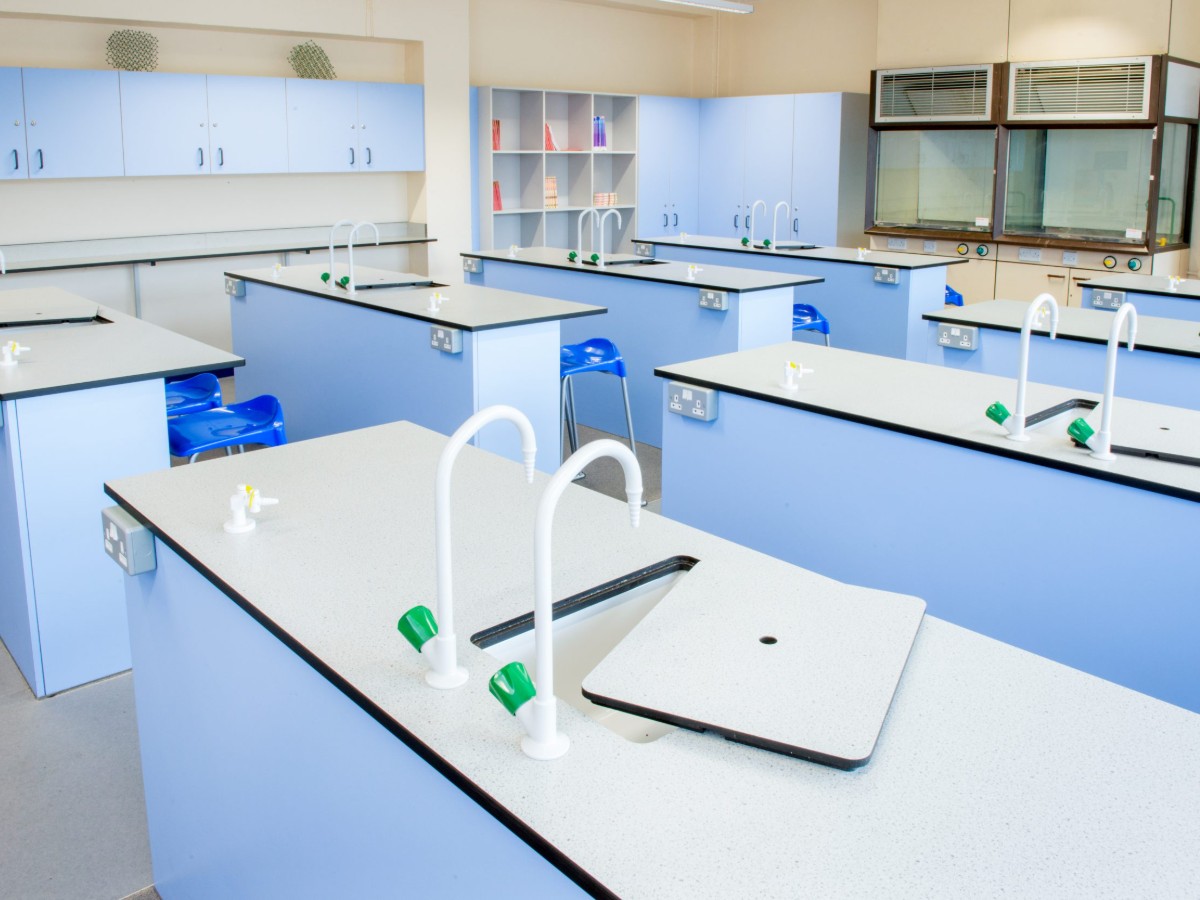
This places significant demands on laboratory design. Fitted furniture must withstand years of intensive daily use while remaining safe, hygienic and easy to maintain. Worktops must resist chemicals, heat and impact. Storage needs to accommodate hazardous substances safely. Service integration for gas, water and electricity must support practical teaching while minimising risk.
Every design decision contributes to creating an environment where learning can take place safely and efficiently. Safety, of course, has always been central to successful science education.
Organisations such as CLEAPSS, which provides health and safety guidance for schools across the UK, place considerable emphasis on laboratory layout, storage, workstations and specialist fittings because the physical environment plays a critical role in reducing risk during practical lessons. Good laboratory fitted furniture supports these objectives.
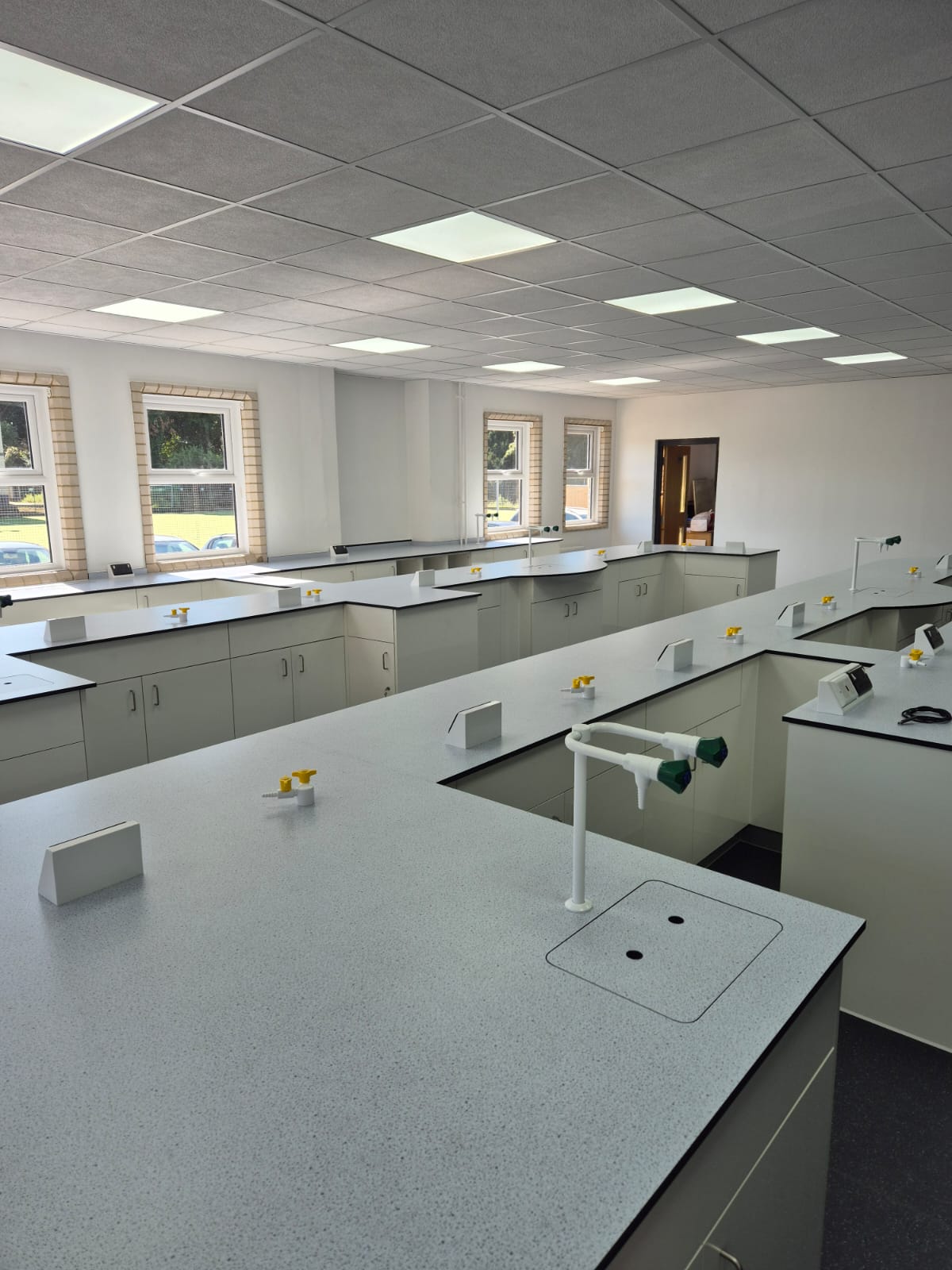
Purpose-designed demonstration benches allow teachers to safely conduct experiments while maintaining clear sightlines across the classroom. Robust storage systems ensure chemicals and equipment are securely housed. Durable work surfaces resist accidental spills and repeated cleaning without deterioration. Perhaps most importantly, thoughtfully designed laboratories help teachers focus on teaching rather than managing unsuitable facilities.
Practical Science Is Under Pressure
Ironically, practical science has never been more important, yet many schools find it increasingly difficult to deliver. A 2025 survey by the Royal Society of Chemistry found that 58% of science teachers cited insufficient time as a barrier to practical lessons, while 43% identified the cost of consumables and chemicals as a major challenge. The survey also highlighted growing concerns about technician shortages, with nearly one in five technicians considering leaving the profession by 2027.
Separate research by EngineeringUK also found that curriculum pressures, limited equipment and funding constraints continue to reduce opportunities for practical science, despite widespread recognition that hands-on experiments are essential for inspiring future STEM careers.
This makes every practical lesson even more valuable. When students do enter the laboratory, the environment should allow teachers to make the very most of that opportunity.
However, unlike many areas of a school, science laboratories place exceptional demands on furniture. Worktops are exposed daily to chemicals, heat, abrasion and heavy equipment. Cupboards and drawers experience constant use throughout the academic year. Services must continue operating reliably despite intensive daily activity.
For this reason, durability becomes every bit as important as appearance. High-quality fitted laboratory furniture represents a long-term investment that supports generations of students while reducing maintenance costs and disruption for schools.
Carefully designed layouts also provide flexibility, allowing laboratories to adapt as teaching methods and curriculum requirements evolve.
Supporting Teachers as Well as Students
We must also be aware that well-designed laboratories benefit more than pupils. Teachers need workspaces that support classroom management, maximise visibility and allow practical demonstrations to take place safely.
Science technicians require efficient storage, logical workflows and reliable furniture capable of supporting equipment preparation throughout the school day. When laboratories are designed around the needs of everyone who uses them, teaching becomes easier, preparation becomes more efficient and learning outcomes can improve.
Functionality alone is no longer enough. Today’s schools increasingly recognise that the physical learning environment influences student engagement. Bright, modern laboratories equipped with professionally designed fitted furniture help create spaces where young people feel inspired to explore, question and experiment.
For many pupils, their first experience of practical science may shape future career decisions, which is why an inspiring laboratory can help transform science from simply another lesson into a subject they genuinely enjoy.
Investing in the Future
At David Bailey Furniture Systems, science laboratories are viewed as far more than fitted furniture projects. They are environments where future careers begin.
Every laboratory is individually designed to meet the specific needs of each school, combining durable materials, intelligent layouts and practical functionality with the highest standards of safety and quality. As demand for STEM skills continues to grow, schools have an increasingly important role in preparing young people for the opportunities ahead.
Outstanding teaching will always remain the single biggest influence on educational success. However, when that teaching takes place within a laboratory designed for safety, practicality and inspiration, it gives students the very best opportunity to discover a lifelong passion for science.
Because today’s school science laboratory may well be where tomorrow’s breakthrough begins.
Related Posts